
According to Gartner, by 2026, 80% of enterprises will have generative AI–enabled applications in production, up from less than 5% in 2023. This rapid adoption reflects real value. GenAI has demonstrated the ability to accelerate content creation by up to 40%, enhance decision quality, and enable hyper-personalized experiences that materially influence customer behavior. However, this implementation-to-value translation may carry significant risks as the technology remains in its learning curve. This blog explores how hybrid AI architectures combine rule-based systems with Generative AI to deliver innovation with enterprise-grade reliability.
Explore hybrid AI architectures built for enterprise trust.
For enterprises operating in regulated fields like compliance-critical workflows, financial calculations, policy enforcement, eligibility checks, and healthcare protocols, the probabilistic nature of large language models introduces unacceptable risk. A financial institution cannot tolerate fabricated account balances, nor can an airline rely on invented refund policies. This tension defines the GenAI dilemma: how can organizations harness GenAI’s transformative potential without compromising the zero-error reliability that enterprise operations require? Enter hybrid AI architectures with rule-based systems and GenAI capabilities.
Understanding the AI Spectrum: Deterministic vs. Generative vs. Hybrid
Enterprise AI systems broadly fall across a spectrum, from deterministic, rule-based automation to probabilistic, generative intelligence. Understanding where each approach excels and where it fails is critical to designing AI systems that are both scalable and trustworthy.
A. Deterministic / Rule-Based Systems
Deterministic systems are designed for zero-error execution. Given a known input, they always produce a predictable and auditable output, making them foundational to enterprise operations. These systems are typically implemented using APIs, SQL-based logic, rules engines, and workflow orchestrators.
They are best suited for structured, repeatable tasks such as PNR validation, invoice and premium calculations, eligibility checks, and status queries. However, their rigidity is also their limitation. Rule-based systems struggle with unstructured inputs, ambiguous queries, and scenarios that require contextual understanding or natural language interaction.
B. Generative AI Systems
Generative AI systems are powered by large language models (LLMs) and are inherently probabilistic. They excel at reasoning over unstructured data and generating human-like responses. In enterprise environments, these systems are commonly implemented using Vertex AI, Gemini, and RAG architectures over curated knowledge bases.
GenAI performs well in various use cases, including policy Q&A, content generation, summarization, and multi-document synthesis. However, these capabilities come with trade-offs. Hallucinations, non-deterministic outputs, and higher compute costs make GenAI unsuitable as a standalone solution for accuracy-critical workflows.
C. The Case for Hybrid
In isolation, neither deterministic systems nor Generative AI can fully meet enterprise requirements. Rule-based systems lack flexibility, while GenAI may not have guaranteed accuracy. This is why hybrid architectures are emerging as the preferred enterprise pattern for high-reliability workflows.
Deterministic automation and RPA systems continue to process transaction volumes up to 3 times higher than pure AI-driven workflows, particularly in operational contexts. At the same time, global AI investment is projected to grow from $235B in 2024 to $630B by 2028, intensifying pressure on enterprises to optimize cost, accuracy, and ROI.
Hybrid AI architectures address this gap by applying GenAI selectively, where reasoning and language add value, while retaining deterministic systems for precision, compliance, and scale.
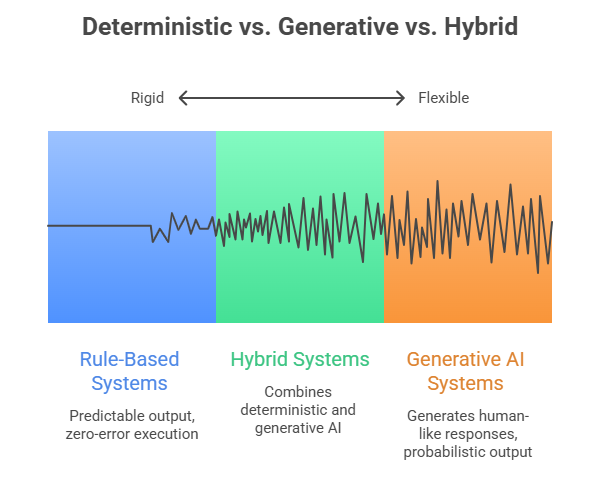
Fig 1: Visual Illustration of Understanding the AI Spectrum: Deterministic vs. Generative vs. Hybrid
H2 Hybrid Architecture Design Patterns
1. The Routing Layer (Decision Engine)
The routing layer is the control plane of a hybrid AI architecture. Its role is to evaluate every incoming request and determine the most appropriate execution path.
Query Classification
- Intent detection using lightweight NLP or embedding-based classifiers
- Complexity scoring based on ambiguity, required context, and compliance sensitivity
- Confidence thresholding to assess deterministic executability
Routing Logic
- Rule-based decision trees for predictable intents
- Pattern matching for structured and deterministic queries
- Confidence-driven routing to the GenAI layer only when required
By centralizing these decisions, the routing layer ensures GenAI is invoked selectively rather than by default.
2. The Rule-Based Layer
The rule-based layer provides deterministic execution for accuracy-critical workflows. It is optimized for low latency, high throughput, and full auditability.
Technical Stack
- Cloud Functions for stateless, serverless rule execution
- Cloud Run for containerized business logic and workflows
- API Gateway for orchestration, authentication, and policy enforcement
Implementation Patterns
- Validation engines (e.g., PNR formats, fare rules, eligibility checks)
- Calculation services (refunds, fare changes, premiums)
- Compliance enforcement against regulatory and business constraints
This layer forms the backbone of enterprise reliability.
3. The Generative AI Layer
The Generative AI layer introduces reasoning, language understanding, and contextual synthesis, capabilities that deterministic systems lack.
Technical Stack
- Vertex AI for model hosting and lifecycle management
- Gemini or PaLM APIs for reasoning and language generation
- Vertex AI Search to implement RAG over curated knowledge bases
Implementation Patterns
- Prompt templates with strict output schemas
- Context injection from the rule-based layer to ground responses
- Output validation, moderation, and guardrails to reduce hallucinations
B. Integration Patterns
1. Sequential Pattern (Rule-First, GenAI-Fallback)
User Query → Routing → Rule Engine → [Success/Failure]
→ If Failure → GenAI Layer → Response
When to Use: High-volume, compliance-critical operations where correctness is mandatory.
Example: Airline disruption handling: deterministic rebooking and refund rules first, with GenAI used only for customer communication or exception handling.
2. Parallel Pattern (Dual Execution)
User Query → Routing → [Rule Engine + GenAI Layer] → Validation → Best ResponseWhen to Use: Complex decision-making and quality assurance scenarios.
Example: Fraud detection, where rules identify risk signals, and GenAI provides explanations or investigative context.
3. Augmented Pattern (GenAI-Enhanced Rules)
User Query → Rule Engine → GenAI (Explanation/Personalization) → ResponseWhen to Use: Deterministic outputs delivered through a conversational interface.
Example: Invoice processing where calculations are rule-driven, but explanations and next steps are generated dynamically for the end user.
Conclusion
Enterprise AI success will be defined not by how extensively Generative AI is used, but by how intelligently it is governed. While GenAI introduces powerful capabilities in reasoning, language, and personalization, its probabilistic nature makes it unsuitable as a standalone solution for accuracy- and compliance-critical workflows.
Hybrid AI architectures resolve this tension by combining deterministic, rule-based systems with Generative AI in a controlled and deliberate manner. Rule engines ensure precision, auditability, and scale, while GenAI is applied selectively to enhance understanding, flexibility, and user experience. Routing layers, confidence-based decisioning, and structured fallback mechanisms turn GenAI from an experimental tool into a dependable enterprise capability. As AI adoption moves from experimentation to scale, hybrid architectures will emerge as the enterprise standard, enabling organizations to innovate faster, control costs, and deliver trusted outcomes without compromising reliability.
To explore how these principles translate into real-world implementations, continue reading the whitepaper for a deeper dive into use-case identification, hybrid decision frameworks, persona-driven applications, and how Google Cloud’s AI stack enables secure, scalable enterprise adoption.